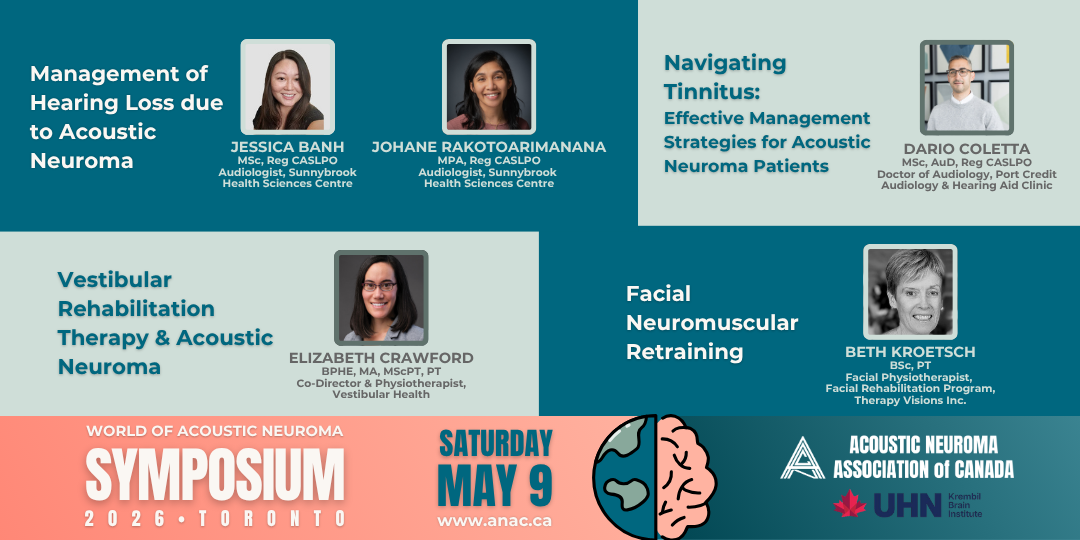
Poster Board 1: Management of Hearing Loss due to Acoustic Neuroma
Presenters: Jessica Banh & Johane Rakotoarimanana (Sunnybrook)
This poster provides an overview of treatment options for hearing loss, including CROS/BiCROS hearing aids, bone conduction implants (BAHA), and cochlear implants (CI). It also outlines how these devices work, their benefits and limitations, and the assessment process for determining candidacy.
Jessica Banh, MSc, Reg CASLPO
Lecturer, Department of Otolaryngology, University of Toronto
Audiologist, Cochlear Implant Program, Sunnybrook Health Sciences Centre
About Jessica ⇓
Jessica Banh earned her Master’s degree in Audiology from Dalhousie University and completed her undergraduate studies at the University of Toronto Mississauga. She has been part of the Cochlear Implant Program at Sunnybrook Health Sciences Centre for the past eight years. She is dedicated to delivering thoughtful, patient‑centered care, with interests in quality improvement initiatives and supporting individuals with single‑sided deafness (SSD). She also holds a lecturer appointment in the Department of Otolaryngology at the University of Toronto.
Johane Rakotoarimanana, MPA, Reg CASLPO
Lecturer, Department of Otolaryngology, University of Toronto
Audiologist, Cochlear Implant Program, Sunnybrook Health Sciences Centre
About Johane ⇓
Johane Rakotoarimanana is a clinical audiologist at Sunnybrook Health Sciences Centre and holds lecturer status in the Department of Otolaryngology at the University of Toronto. She completed her studies in audiology at the Université de Montréal.
Poster Board 2: Navigating Tinnitus – Effective Management Strategies for Acoustic Neuroma Patients
Presenter: Dario Coletta (Port Credit Audiology & Hearing Aid Clinic)
This poster outlines current approaches to tinnitus management, including sound therapy, structured tinnitus programs, counselling strategies, and lifestyle considerations aimed at improving quality of life.
Dario Coletta, MSc, AuD, Reg CASLPO
Doctor of Audiology, Port Credit Audiology & Hearing Aid Clinic (Mississauga, ON)
About Dario ⇓
Dario Coletta is an Audiologist working in private practice in Mississauga, ON at Port Credit Audiology & Hearing Aid Clinic. He obtained his Doctor of Audiology from A.T. Still University and Master of Science in Audiology from the University of British Columbia. His main interests in the field of audiology include amplification, tinnitus counselling and management, diagnostics, and hearing loss prevention. Dario is committed to helping patients find an individualized solution for their hearing health care concerns.
Poster Board 3: Vestibular Rehabilitation and Acoustic Neuroma
Presenter: Elizabeth Crawford (Vestibular Health)
This presentation explores the vestibular system and the principles of vestibular rehabilitation. It highlights the role of vestibular therapy throughout the patient journey, includes acoustic neuroma-specific patient data, and discusses expected outcomes from therapy.
Elizabeth Crawford, BPHE, MA, MScPT, PT, Certificate in Vestibular Rehabilitation
Co-Director & Physiotherapist, Vestibular Health, located at Toronto General Hospital, University Health Network (UHN) & Hennick Bridgepoint Hospital, Sinai Health System
About Elizabeth ⇓
Elizabeth Crawford is the co-director of Vestibular Health. She is a compassionate and knowledgeable physiotherapist with expertise in vestibular and neurological rehabilitation.
Elizabeth is part of the Hertz Multidisciplinary Neuro-Otology Clinic at the University Health Network. She is an Advanced Practice Vestibular Physiotherapist in the Enhanced Dizzy Assessment Clinic at Toronto General Hospital, an initiative to reduce wait times for patients in need of specialized medical care for dizziness/vertigo. During her work in the Hertz Clinic and as an Advanced Practice provider, she has gained knowledge of complex inner ear and neurological conditions and their impacts on balance function.
Elizabeth has a Certificate in Vestibular Rehabilitation through Emory University, and has advanced vestibular training through the University of Pittsburgh. Her clinical background is in neurological and complex traumatic injury rehabilitation. Elizabeth has extensive experience working with both community- and hospital-based multidisciplinary teams, focused on people with neurological disorders, persistent post-concussion symptoms, vestibular disorders, balance and gait impairments, and dizziness.
Poster Board 4: Facial Neuromuscular Retraining
Presenter: Beth Kroetsch (Therapy Visions Inc.)
Focused on facial nerve recovery, this poster reviews causes of facial nerve paresis, stages of recovery, and the key components of facial neuromuscular retraining (FNMR), supported by clinical examples.
Beth Kroetsch, BSc, PT
Facial Physiotherapist, Facial Rehabilitation Program, Therapy Visions Inc., located at S.L. Hunter Speech Works (Burlington, ON)
About Beth ⇓
Beth graduated from the University of Western Ontario in 1982 with a Bachelor of Science in Physical Therapy and has pursued advanced training in orthopedics and manual therapy, facial nerve rehabilitation, vestibular rehabilitation, and pelvic floor physiotherapy.
Her career spans hospital and private practice, along with a decade (2007–2017) as a sports physiotherapist for Canada’s Women’s National Paralympic Wheelchair Basketball Team.
Facial rehabilitation is her primary area of expertise. She treats a wide range of conditions, including acoustic neuroma (vestibular schwannoma), facial nerve disorders, and head and neck conditions.
Beth established the Facial Rehabilitation Program at Joseph Brant Memorial Hospital in 1992. Now based in Burlington at S. L. Hunter SpeechWorks, she continues to treat patients while training clinicians in facial neuromuscular retraining—an area with limited specialized expertise in Ontario.
Back to 2026 Symposium Program